
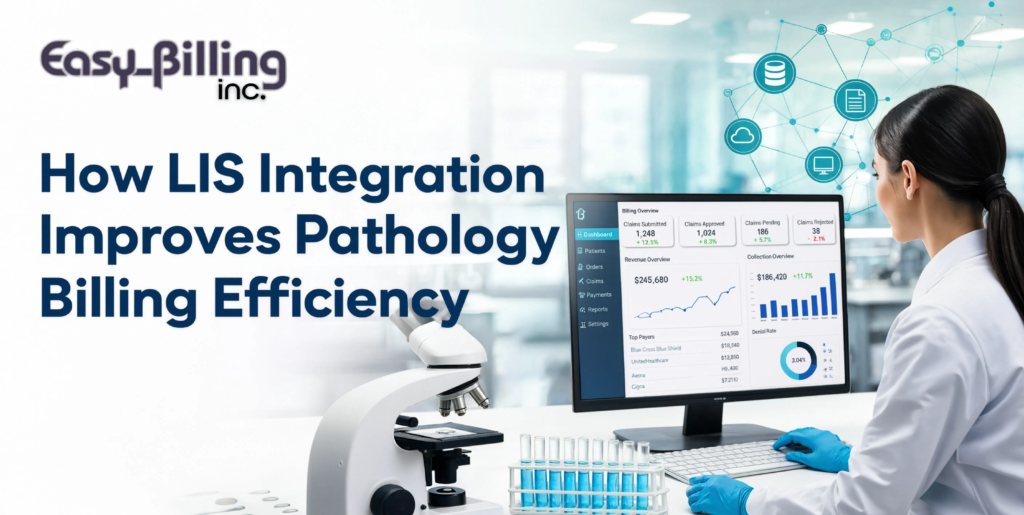
Pathology billing requires precision, speed, and accurate data management. From laboratory testing and specimen tracking to insurance claims and reimbursements, pathology practices handle large amounts of information every day. Even minor documentation errors can lead to delayed payments, rejected claims, and administrative inefficiencies.
This is why LIS integration has become increasingly important for modern pathology practices. Integrating a Laboratory Information System (LIS) with medical billing software helps streamline workflows, improve billing accuracy, and reduce manual administrative work.
In this article, we will explain how LIS integration improves pathology billing efficiency and why integrated systems are essential for pathology labs looking to optimize revenue cycle management.
What Is LIS Integration?
A Laboratory Information System (LIS) is software used by pathology labs to manage patient information, specimen tracking, laboratory workflows, test results, and reporting. LIS integration connects the laboratory system with medical billing software such as Easy Billing Pro so that information can move automatically between systems.
Without integration, billing teams often need to manually transfer laboratory data into the billing platform. This process can consume significant time and increase the likelihood of errors. An integrated workflow automatically synchronizes patient details, laboratory orders, test codes, and billing information, helping practices operate more efficiently.
Why Pathology Billing Is More Complex
Pathology billing is often more complicated than standard medical billing because it involves high test volumes and multiple layers of documentation. Laboratories frequently process complex claims that require accurate patient information and complete test documentation.
When laboratory systems and billing systems are disconnected, staff members may need to repeatedly enter the same information across multiple platforms. This creates inefficiencies and increases the risk of claim denials due to incomplete or inaccurate data. Integrated systems help pathology practices reduce these challenges by creating a more centralized and automated workflow.
LIS Integration Improves Pathology Billing Efficiency
Streamline pathology billing workflows with seamless LIS integration that reduces manual data entry and improves claim accuracy. Enhance operational efficiency, accelerate reimbursements, and simplify laboratory-to-billing communication with integrated billing solutions.
Reduces Manual Administrative Work
One of the biggest advantages of LIS integration is the reduction in manual data entry. Instead of entering patient demographics, physician information, and laboratory details into multiple systems, the information transfers automatically between the LIS and billing software.
This not only saves time but also helps staff focus on higher-value tasks such as claim management and revenue optimization. Reducing repetitive administrative work can significantly improve productivity within pathology practices.
Improves Billing Accuracy
Billing accuracy is essential for maintaining a healthy revenue cycle. Small errors in patient details or laboratory records can result in denied or delayed claims.
With LIS integration, pathology practices can ensure that information remains consistent throughout the billing process. Automated data transfer reduces the chances of missing documentation or incorrect entries.
As a result, claims are often cleaner, more accurate, and easier to process. Improved claim accuracy can help practices reduce reimbursement delays and improve overall financial performance.
Speeds Up Claim Processing
Disconnected workflows often slow down billing operations because staff members must manually verify and transfer information before submitting claims. Integrated systems eliminate many of these delays by creating a seamless flow of information between departments.
When billing teams receive laboratory data automatically, they can prepare and submit claims more quickly. Faster claim processing can improve cash flow and help pathology practices maintain more consistent revenue cycles.
Enhances Reporting and Financial Visibility
Pathology labs generate large amounts of operational and financial data. Without centralized reporting tools, tracking claim performance and identifying revenue issues can become difficult. Integrated billing systems provide better visibility into:
- Claim status and reimbursements
- Outstanding balances and aging reports
- Revenue trends and billing performance
- Workflow bottlenecks and denial patterns
Advanced reporting capabilities within Easy Billing Pro help pathology practices make more informed financial and operational decisions.
Helps Reduce Claim Denials
Claim denials are a major concern for pathology practices because they can disrupt cash flow and increase administrative workload. Many denials occur due to missing documentation or inconsistent patient information.
LIS integration helps minimize these issues by ensuring that laboratory data is transferred accurately into the billing system. When information remains synchronized across workflows, practices can reduce the risk of incomplete claims and improve reimbursement success rates.
Supports Workflow Automation
Automation plays an increasingly important role in healthcare billing efficiency. LIS integration helps automate several billing-related processes, including charge entry, claim preparation, data synchronization, and status tracking.
By reducing dependence on manual processes, pathology practices can create faster and more scalable workflows. Automation also allows staff members to spend less time correcting errors and more time focusing on patient care and operational management.
The Importance of HL7 Integration
HL7 integration is commonly used to support communication between healthcare systems, including LIS platforms and billing software. HL7 standards allow systems to exchange data securely and consistently, helping pathology labs maintain smooth operational workflows.
Efficient HL7 integration supports better interoperability between laboratory systems, billing platforms, and healthcare providers. This improves communication across departments and helps pathology practices maintain more accurate records throughout the billing cycle.
Choosing the Right Integrated Billing Software
When selecting pathology billing software, practices should prioritize solutions that support integration, automation, and reporting capabilities. Features such as HL7 compatibility, automated claims processing, custom reporting, and secure patient data management can significantly improve operational efficiency.
Solutions like Easy Billing Pro are designed to help pathology practices streamline billing operations while supporting integrated laboratory workflows.
Final Thoughts
LIS integration has become an essential part of improving pathology billing efficiency. By connecting laboratory systems with medical billing software, pathology practices can reduce administrative workload, improve claim accuracy, speed up reimbursements, and create more streamlined workflows.
Integrated systems also help pathology labs improve reporting, reduce claim denials, and strengthen overall revenue cycle management. As pathology billing continues to become more complex, practices that invest in integrated workflows will be better positioned to improve operational efficiency and long-term financial performance.